Sunday, February 9, 2020
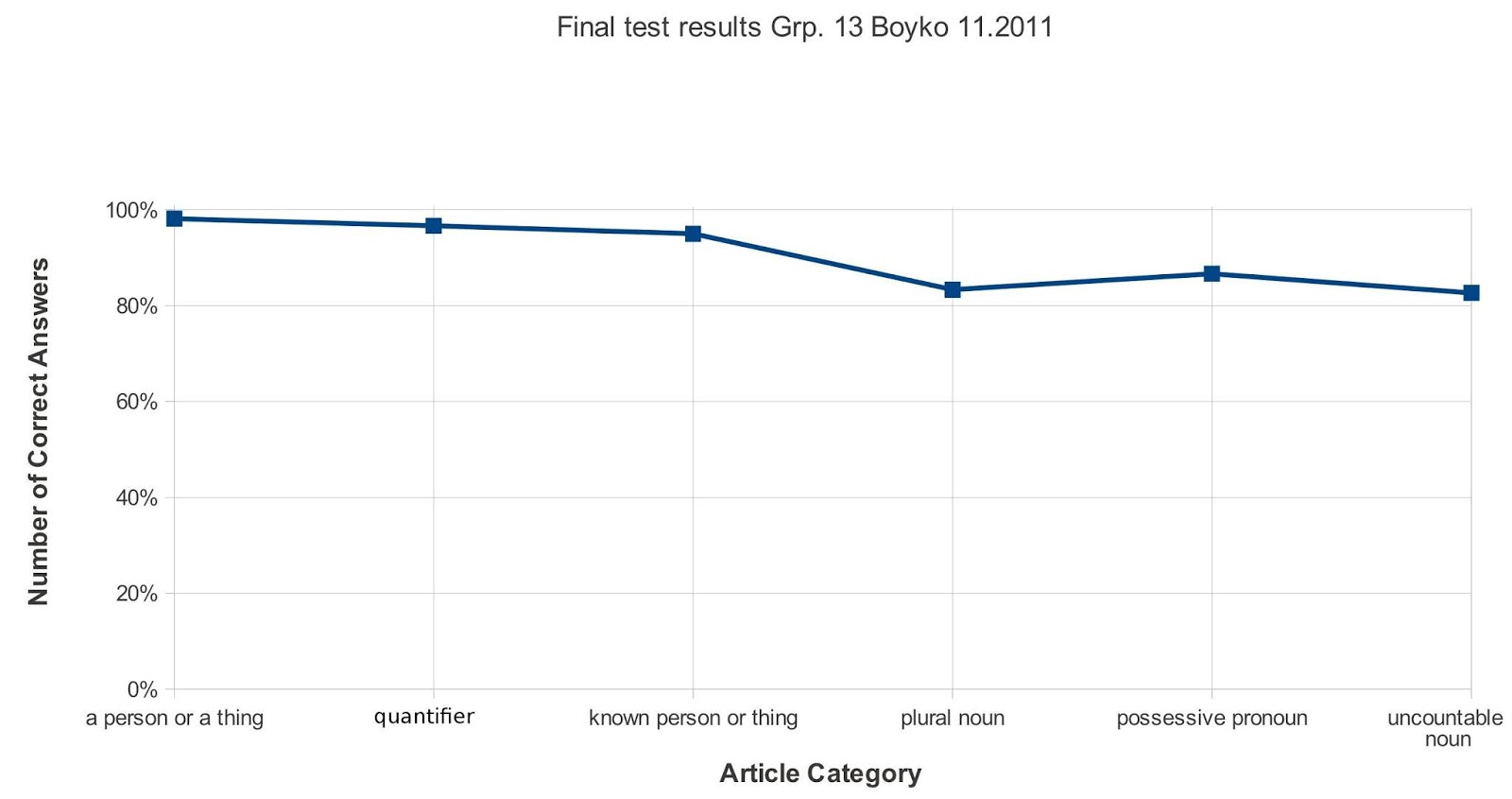
Work group results of the final test, Rivne, 2011
Control Group and Work Group Test Result Comparison, Rivne 09
Control Group and Work Group Test Result Comparison
Unfortunately we were unable to meet with the students to get the results of the final exam.
COMPARISON OF PROFICIENCY IN ARTICLE USAGE 2012
Chart comparing test results of the Article Pre-test
This chart shows the uniformity of problems with Article Usage. We compared the results of students at 2 Ukrainian universities: РДГУ, Rivne, and the Ostrog Academy in Ostrog.
RRI research project on the English Article
THE PROBLEM OF THE ENGLISH ARTICLE FOR UKRAINIANS LEARNING ENGLISH AS A SECOND LANGUAGE
TESOL conference in Rivne, Ukraine April, 2010
I was visiting a lady who lives near L'viv a few years ago, and near the end of the visit she told me that "the husband was soon coming home..." this little anecdote illustrates the problems of correctly using the article, and the confusion or amusement it can cause for the hearer. These errors are typically use of the article and preposition, also pronunciation and collocation errors which have created a specific “Ukrainian English”.
This course will focus on these types of errors, by alerting students to the error, correcting the error, and with various types of practice hopefully eliminate the error before it becomes fossilized in the students' speech.
The university has agreed for me to work with the fourth year psychology students who are studying English as their only foreign language. The class is split into 2 subgroups, group A and group B. I will work with one subgroup, the other group is the control group.
At the beginning of the course both groups will take the same test. I will work with group A once a week; group B will not participate in my course. My work with group A will consist of fill in the black exercises, drills, communicative games, role play and other types of activities to teach and reinforce the correct forms in the students' minds. My weekly lessons will follow the set curriculum of the group's normal English classes.
After working with the fourth year students for one year I will administer a test again to both groups to check if there is any improvement in group A in comparison to group B. If students do well on this test I would recommend giving them enough points to raise their mark one point at the end of the spring term. It is too early to have any results yet from our observations, but we have detected some patterns in the errors made, as listed:
• Percentage of correct answers in English Article test
• Superlative 90,00%
• you know which one 63,00%
• things in general 51,00%
• plural noun 43,00%
• only one around 72,00%
• place names exception 84,00%
• a closed group with a limited number of members 58,00%
• uncountable noun 38,00% • proper noun 70,00%
• one person or thing 55,00% • expression of quantity 74,00%
The problem of the English article is one that has been explored for many years. Otto Jespersen, a Danish grammarian wrote A Modern English Grammar on Historical Principles. The Article was addressed in this work as well as in other current publications such as The English Article by Stoudinets, published in Kyiv in 2006.
Conclusion A native speaker may be able to detect and correct these errors more readily; the native speaker does face the limitations of never having studied English as a foreign language. This presents certain challenges, such as having to learn grammar rules in order to explain why something doesn't "sound right" But with enough drill and practice of correct article use, it's possible that even a native English speaker will understand the "logic" behind the need for articles in the English language!
Here are the result of pretesting 2 groups of first year student in Rivne.
TESOL conference in Rivne, Ukraine April, 2010
I was visiting a lady who lives near L'viv a few years ago, and near the end of the visit she told me that "the husband was soon coming home..." this little anecdote illustrates the problems of correctly using the article, and the confusion or amusement it can cause for the hearer. These errors are typically use of the article and preposition, also pronunciation and collocation errors which have created a specific “Ukrainian English”.
This course will focus on these types of errors, by alerting students to the error, correcting the error, and with various types of practice hopefully eliminate the error before it becomes fossilized in the students' speech.
The university has agreed for me to work with the fourth year psychology students who are studying English as their only foreign language. The class is split into 2 subgroups, group A and group B. I will work with one subgroup, the other group is the control group.
At the beginning of the course both groups will take the same test. I will work with group A once a week; group B will not participate in my course. My work with group A will consist of fill in the black exercises, drills, communicative games, role play and other types of activities to teach and reinforce the correct forms in the students' minds. My weekly lessons will follow the set curriculum of the group's normal English classes.
After working with the fourth year students for one year I will administer a test again to both groups to check if there is any improvement in group A in comparison to group B. If students do well on this test I would recommend giving them enough points to raise their mark one point at the end of the spring term. It is too early to have any results yet from our observations, but we have detected some patterns in the errors made, as listed:
• Percentage of correct answers in English Article test
• Superlative 90,00%
• you know which one 63,00%
• things in general 51,00%
• plural noun 43,00%
• only one around 72,00%
• place names exception 84,00%
• a closed group with a limited number of members 58,00%
• uncountable noun 38,00% • proper noun 70,00%
• one person or thing 55,00% • expression of quantity 74,00%
The problem of the English article is one that has been explored for many years. Otto Jespersen, a Danish grammarian wrote A Modern English Grammar on Historical Principles. The Article was addressed in this work as well as in other current publications such as The English Article by Stoudinets, published in Kyiv in 2006.
Conclusion A native speaker may be able to detect and correct these errors more readily; the native speaker does face the limitations of never having studied English as a foreign language. This presents certain challenges, such as having to learn grammar rules in order to explain why something doesn't "sound right" But with enough drill and practice of correct article use, it's possible that even a native English speaker will understand the "logic" behind the need for articles in the English language!
Here are the result of pretesting 2 groups of first year student in Rivne.
Wednesday, November 5, 2014
Halloween Lesson
The past two weeks' lessons were on Halloween. Each lesson was slightly different from the rest- different levels of English, lots of material. I just went with what seemed to work for the particular group. So, I'll just post all of what I used and leave it at that!
--Started each class by drawing a calendar showing October on the white board and indicating Oct 31. What's this? What's this day?
--Brainstorm words about Halloween
--Show a short series of pictures depicting American Halloween (I googled 'Halloween images' and just chose about 6 of those, plus used a pic of friend's daughter and her Trick-or-Treat haul.)
--Short audio about history of Halloween (this could be worked up in quite a bit more detail; I picked out words/phrases I wanted them to understand and wrote them on the white board as they heard them and then asked the students about them. Also asked if they needed other words explained) note- this is actually a National Geographic video on YouTube but I can only play audio, don't actually have access to the video.
--When using the Dracula text, asked leading questions about vampires first. Read text, cover new words and phrases (there are MANY). They tend to ask a lot of questions about the text itself which lead to discussion.
The Terrifying Truth About Dracula
Idioms used (and which MUST be introduced. This is nearly an entire lesson on its own.)
Death/Dead/Dying idioms (student cards)
Death/Dead/Dying idioms (teacher doc)
Devil Idioms (student cards)
Devil Idioms (teacher doc)
Sentences to illustrate these idioms
(Many of the idioms and sentences come from here (death) (devil) although quite a few are my own)
For fun, used this playlist when student were involved in group activities (getting their skits ready, playing the games)
--Started each class by drawing a calendar showing October on the white board and indicating Oct 31. What's this? What's this day?
--Brainstorm words about Halloween
--Show a short series of pictures depicting American Halloween (I googled 'Halloween images' and just chose about 6 of those, plus used a pic of friend's daughter and her Trick-or-Treat haul.)
--Short audio about history of Halloween (this could be worked up in quite a bit more detail; I picked out words/phrases I wanted them to understand and wrote them on the white board as they heard them and then asked the students about them. Also asked if they needed other words explained) note- this is actually a National Geographic video on YouTube but I can only play audio, don't actually have access to the video.
--When using the Dracula text, asked leading questions about vampires first. Read text, cover new words and phrases (there are MANY). They tend to ask a lot of questions about the text itself which lead to discussion.
The Terrifying Truth About Dracula
How a 15th-century Wallachian prince became a
frightening modern legend
by David Johnson
|
The rugged
Transylvanian Alps provide one of the most spectacular landscapes in Europe.
Hawks soar around the craggy, snow-covered peaks, while bears and chamois take
refuge in the dense forests below. Medieval villages and the ruins of
once-proud castles can abruptly materialize through the mist, as if daring
outsiders to uncover their secrets.
Transylvania
also produced a leader known as a defender of the Christian faith, a Romanian
hero, and a subhuman monster. His name was Prince Vlad, but the world knows him
by his nickname: Dracula.
The Order of the Dragon
Vlad, or
Dracula, was born in 1431 in Transylvania into a noble family. His father was
called "Dracul," meaning "dragon" or "devil" in
Romanian because he belonged to the Order of the Dragon, which fought the
Muslim Ottoman Empire.
"Dracula"
means "son of Dracul" in Romanian. Therefore young Vlad was "son
of the dragon" or "son of the devil." Scholars believe this was
the beginning of the legend that Dracula was a vampire.
Warrior in Chains
Dracula lived
in a time of constant war. Transylvania was at the frontier of two great
empires: the Ottoman Turks and the Austrian Hapsburgs. Treachery,
vindictiveness, and revenge ruled the day, as young Dracula soon discovered.
Dracula was
imprisoned, first by the Turks, who hauled him away in chains, and later by the
Hungarians. Dracula's father was murdered, while his older brother, Mircea, was
blinded with red-hot iron stakes and buried alive.
Vlad the Impaler
From 1448 until
his death in 1476, Dracula ruled Walachia and Transylvania, both part of
Romania today. Twice he lost and reclaimed his throne, once by fighting his own
brother, Radu. Although the Vatican once praised him for defending
Christianity, it disapproved of his methods, which soon became infamous.
Dracula earned
another nickname, "Vlad Tepes" (pronounced tsep-pesh), which means
"Vlad the Impaler." Dracula's favorite method of torture was to
impale people and leave them to writhe in agony, often for days. As a warning
to others, the bodies would remain on rods as vultures and blackbirds nibbled
the rotting flesh.
During one
battle, Dracula retreated into nearby mountains, impaling people as he went.
The Turkish advance was halted because the sultan could not bear the stench
from the decaying corpses.
Another time,
Dracula was reported to have eaten a meal on a table set up outside amidst
hundreds of impaled victims. On occasion he was also reported to have eaten
bread dipped in blood.
Defender of the Faith
At that time it
was believed that religious charity, and a proper burial, would erase sin and
allow entry to heaven. Dracula surrounded himself with priests and monks and
founded five monasteries. Over a period of 150 years, his family established 50
monasteries.
Killed in
December 1476 fighting the Turks near Bucharest, Romania, Dracula's head was
cut off and displayed in Constantinople.
The Corpse Disappears
Dracula was
buried at the isolated Snagov Monastery near Bucharest, which was also likely
used as a prison and torture chamber. When prisoners prayed before an icon of
the Blessed Virgin, a trap door opened dropping them onto sharp stakes below.
In 1931
archaeologists searching Snagov found a casket partially covered in a purple
shroud embroidered with gold. The skeleton inside was covered with pieces of
faded silk brocade, similar to a shirt depicted in an old painting of Dracula.
The casket also
contained a cloisonné crown, with turquoise stones. A ring, similar to those
worn by the Order of the Dragon, was sewn into a shirtsleeve.
The contents
were taken to the History Museum in Bucharest but have since disappeared
without a trace, leaving the mysteries of the real Prince Dracula unanswered.
Bad
Moon Rising – Creedence Clearwater Revival
|
I see the bad moon arising.
I see trouble on the way.
I see earthquakes and lightnin’.
I see bad times today.
|
Don’t go around tonight,
Well it’s bound to take your life,
There’s a bad moon on the rise.
|
I hear hurricanes a’blowin’.
I know the end is coming soon.
I fear rivers overflowin’.
I hear the voice of rage and ruin.
|
Don’t go around tonight,
Well it’s bound to take your life,
There’s a bad moon on the rise.
|
Hope you got your things together.
Hope you are quite prepared to die.
Looks like we’re in for nasty weather.
One eye is taken for an eye.
|
Well don’t go around tonight,
Well it’s bound to take your life,
There’s a bad moon on the rise.
|
Don’t come around tonight.
Well it’s bound to take your life.
There’s a bad moon on the rise.
|
Cover new vocab. Ask questions that get them to come up with word 'omen'. (What is the song about? What is a 'bad moon'? What bad signs does it talk about in the song? What are these things? I keep writing down words and phrases- mostly they come up with it.)
-- Discussion questions about Halloween
What legends about scary Halloween
characters do you know?
|
Do you believe in bad omens? Why or
why not? Which ones frighten you or do you believe in?
|
Tell us about a horror movie you’ve
seen or a horror book you’ve read.
|
What Halloween traditions do you know
about and which ones would you like to celebrate in Ukraine?
|
Tell me about some legendary Ukrainian
scary characters.
|
Some people say that Halloween
encourages an interest in devil-worship and the occult. Do you think Halloween
is harmful or harmless? Is it ok for Christians to celebrate Halloween?
|
They tend to love to talk about Ukrainian 'scary' characters. Talking about the various superstitions and how to protect yourself from them is also a favorite.
--Trick-or-Treat Game
![]() |
| This is the same game Karen referred to here |
Death/Dead/Dying idioms (student cards)
Death/Dead/Dying idioms (teacher doc)
Devil Idioms (student cards)
Devil Idioms (teacher doc)
Sentences to illustrate these idioms
(Many of the idioms and sentences come from here (death) (devil) although quite a few are my own)
For fun, used this playlist when student were involved in group activities (getting their skits ready, playing the games)
Labels:
Anita,
english conversation,
Halloween,
music4teaching
Lesson 4 Oct/Nov, 2014 (Vigilantism)
Start out by passing out lyric sheets and playing Beer for My Horses. For the most part, this is an easy lesson. They tend to love the song and the idea is easy for Ukrainian students to understand right now.
--Go over vocab/phrases they need to have clarified. Make sure they understand what 'saddle up', 'draw a hard line', 'long arm of the law', 'settle down' mean.
--Go over themes in the song (they should remember the song from lesson 1 and easily recall this)
--Introduce the words 'vigilante', 'vigilante justice', 'vigilantism'
ask appropriate questions: What is vigilante justice? Does it happen in Ukraine? (Interesting that most of the students don't think it does until I bring up specific instances: The citizens of Ternopil publicly shaming their police and special forces as well as other public employees last winter; the burning of Ternopil police headquarters the night of Feb 18. There are quite a lot of recorded instances from the past year, actually. This becomes an easy discussion then.) Why does it happen? Is it OK? When? When isn't it?
--Pass out text : Vigilante is Spanish for watchman, guard; from vigilante vigilant, from Latin vigilant-, vigilans.
Vigilante justice (also called frontier justice or street justice) is extrajudicial punishment (punishment by the state or someone else carried out without legal process or supervision from a court or tribunal through a legal proceeding) that is motivated by the nonexistence of law and order or dissatisfaction with justice. Lynching and gun-fighting are forms of vigilante justice.
During the 19th century in the US many areas of the Wild West had no established institutions of law and order. This led the local community to literally take the law into its own hands and dispense justice through Vigilante Committees.
In San Francisco news of the discovery of gold to the north depleted the police force while simultaneously triggering a population explosion. The resulting increase in crime and violence prompted the establishment of a Vigilante committee to maintain law and order. The Committee was made up of 600 local volunteers, most of whom were prominent members of the business community. During its first year (1851), the Committee hanged four law breakers, whipped one, deported 20 and released 41 after trial. As a result, violent crime was reduced in the city.
Vigilantism happens in the 21st century as well. It is often spurred on by the perception that criminal punishment is either nonexistent or insufficient for the crime.
Those who believe this see their governments as ineffective in enforcing the law; thus, such individuals fulfill the like-minded wishes of the community. In other instances, a person may choose a role of vigilante as a result of personal experience as opposed to a social demand.
Persons seen as "escaping from the law" or "above the law" are sometimes the targets of vigilantism. It may target persons or organizations involved in illegal activities in general or it may be aimed against a specific group or type of activity, e.g. police corruption. Other times, governmental corruption is the prime target of vigilante freedom fighters.
Vigilante behavior may differ in degree of violence. In some cases vigilantes may assault targets verbally, physically attack them or vandalize their property. Anyone who defies the law to further justice is a vigilante, and thus violence is not a necessary criterion.
In New York City on December 22, 1984, Bernhard Goetz shot four young black men when they tried to mug him. He was eventually arrested and tried on several criminal counts but a jury found him not guilty of all charges except the one for carrying an unlicensed firearm. Mr Goetz was dubbed the ‘Subway Vigilante’ by the NYC press and came to symbolize New Yorkers’ frustrations with the high crime rates of the 1980’s. He was both praised and vilified in the media and public opinion.
In Ukraine, Amnesty International has raised concerns of vigilantism by many people during the recent crisis- including both pro-Kyiv and separatist groups. In particular, Amnesty International has accused Oleg Lyashko of this: Oleg Lyashko is supposed to be a lawmaker, but he has taken the law into his own hands.(references: vigilante, Wikipedia, Princeton.edu, amnesty international, Bernhard Goetz)
--Talk a bit about the 2 mentioned (Goetz and Lyashko). Hero? Villain?
--Divide class into 2 groups (One class was small so I used only one discussion card.) Give each group a discussion card.
--Go over vocab/phrases they need to have clarified. Make sure they understand what 'saddle up', 'draw a hard line', 'long arm of the law', 'settle down' mean.
--Go over themes in the song (they should remember the song from lesson 1 and easily recall this)
--Introduce the words 'vigilante', 'vigilante justice', 'vigilantism'
ask appropriate questions: What is vigilante justice? Does it happen in Ukraine? (Interesting that most of the students don't think it does until I bring up specific instances: The citizens of Ternopil publicly shaming their police and special forces as well as other public employees last winter; the burning of Ternopil police headquarters the night of Feb 18. There are quite a lot of recorded instances from the past year, actually. This becomes an easy discussion then.) Why does it happen? Is it OK? When? When isn't it?
--Pass out text : Vigilante is Spanish for watchman, guard; from vigilante vigilant, from Latin vigilant-, vigilans.
Vigilante justice (also called frontier justice or street justice) is extrajudicial punishment (punishment by the state or someone else carried out without legal process or supervision from a court or tribunal through a legal proceeding) that is motivated by the nonexistence of law and order or dissatisfaction with justice. Lynching and gun-fighting are forms of vigilante justice.
During the 19th century in the US many areas of the Wild West had no established institutions of law and order. This led the local community to literally take the law into its own hands and dispense justice through Vigilante Committees.
In San Francisco news of the discovery of gold to the north depleted the police force while simultaneously triggering a population explosion. The resulting increase in crime and violence prompted the establishment of a Vigilante committee to maintain law and order. The Committee was made up of 600 local volunteers, most of whom were prominent members of the business community. During its first year (1851), the Committee hanged four law breakers, whipped one, deported 20 and released 41 after trial. As a result, violent crime was reduced in the city.
Vigilantism happens in the 21st century as well. It is often spurred on by the perception that criminal punishment is either nonexistent or insufficient for the crime.
Those who believe this see their governments as ineffective in enforcing the law; thus, such individuals fulfill the like-minded wishes of the community. In other instances, a person may choose a role of vigilante as a result of personal experience as opposed to a social demand.
Persons seen as "escaping from the law" or "above the law" are sometimes the targets of vigilantism. It may target persons or organizations involved in illegal activities in general or it may be aimed against a specific group or type of activity, e.g. police corruption. Other times, governmental corruption is the prime target of vigilante freedom fighters.
Vigilante behavior may differ in degree of violence. In some cases vigilantes may assault targets verbally, physically attack them or vandalize their property. Anyone who defies the law to further justice is a vigilante, and thus violence is not a necessary criterion.
In New York City on December 22, 1984, Bernhard Goetz shot four young black men when they tried to mug him. He was eventually arrested and tried on several criminal counts but a jury found him not guilty of all charges except the one for carrying an unlicensed firearm. Mr Goetz was dubbed the ‘Subway Vigilante’ by the NYC press and came to symbolize New Yorkers’ frustrations with the high crime rates of the 1980’s. He was both praised and vilified in the media and public opinion.
In Ukraine, Amnesty International has raised concerns of vigilantism by many people during the recent crisis- including both pro-Kyiv and separatist groups. In particular, Amnesty International has accused Oleg Lyashko of this: Oleg Lyashko is supposed to be a lawmaker, but he has taken the law into his own hands.(references: vigilante, Wikipedia, Princeton.edu, amnesty international, Bernhard Goetz)
--Divide class into 2 groups (One class was small so I used only one discussion card.) Give each group a discussion card.
Card One:
-
You were on the metro in Kyiv during the morning
rush hour. You were pick-pocketed AND
you know who did it. You filled out the proper papers at the police station but
after two weeks, nothing has been done. You have some pretty intimidating
friends; you know where to find the person who robbed you.
-
In your group, decide whether or not you will
pursue this on your own or leave it up to the police.
-
Discuss legal options you have.
-
Talk about What you will do and How.
Give
us as many details as you can!
Card Two:
-
It’s 1867, New Mexico (which is a US Territory).
You have a cattle ranch and about 10 cowboys who help you work the ranch. You
know that cattle thieves have been rustling (stealing)
your cattle. In the past year, you estimate you have lost more than 50 cows.
-
Each person in your group is a rancher in a
similar situation. You decide to form a posse and go after the rustlers.
-
Describe in detail What you will do and How.
-
Talk about how many cowboys there will be all
together.
Give
us as many details as you can!
As already noted, this was an easy lesson and, in my opinion, an excellent one for these kids right now.
Wednesday, October 8, 2014
Lesson 3, Sep/Oct 2014 (Brilliant Disguise)
Still working on this lesson- not satisfied with it. First go at it last week; 2nd go today. Need to add something to help them get the point, to tie it all together!
Start out by asking if they'd ever heard of someone finding out that their quiet next door neighbor was, in fact, a notorious criminal. Trying to work in the current issue of the worldwide hunt for the last of the Nazi war criminals. One who is currently being investigated is, in fact, a Ukrainian. This might not be the way to focus on this issue! Would like to use this article to create a short text to read at the beginning of class.
Need more/better questions/something structured for talking about whether or not we know the people who are close to us.
Pass out lyric sheets and have students follow along with Bruce Springsteen's song 'Brilliant Disguise'
- go over unfamiliar vocab and ideas in the song (obviously they have to know what a disguise is)
- Who are the people in the song?
- Do they know each other, really?
- What do we hide from each other?
- Is it ok for married people to hide things from each other?
- What?
(Side issue- What makes a marriage last for many years?- I don't think it ever hurts to talk about this with these kids!)
- Have you ever thought you knew someone well only to find out you didn't?
Pass out copies of the
classroom handout and go over any unknown vocabulary. Tell students that they are going to find out which of their classmates
have had these exciting experiences. They can ask anyone in the class any
question; if the person says "yes," they need to ask at least three
follow-up questions to get the story.
Instruct students to get up (they always want to remain seated and quietly talk to their neighbors only) and start asking
questions. They do not have to start at number one, nor do they have to get
through all of the questions on the list. Instead, they should choose the ideas
they find the most intriguing and use these as the starting point for good
conversations.
Students should very quickly become engaged in
telling their personal stories. During this time, you can circulate and
encourage individual students to elaborate on their experiences.
With about ten minutes left in the lesson, call
the class back together. Ask individual students to report on the most
interesting/surprising/exciting story that they heard. Encourage students to
retell the story, asking the original classmate for clarifications if
necessary. You could also ask for a report back on one of the topics. For
example "Did anyone find a classmate who has a tattoo?" (from this site)
Find out if someone in your
class:
1.
has had a problem with
the police
2.
has almost died
3.
has met a famous person
4.
has had a frightening
experience on an airplane
5.
has had a premonition or
experienced ESP
6.
has had a dream that
later came true
7.
has fallen in love with
a person they could not have
8.
has been on a terrible
date
9.
has gotten a tattoo
10.
has performed a
daredevil act
11.
has backpacked in a
foreign country
12.
has eaten something
disgusting
13.
has won something (for
example, the lottery. a contest)
Listening to them relate what they learned is a blast. So far, no one has come up with any huge 'finds'- but they can relate bad dates and food a few even have ESP... ;) Something to watch here- the definition of 'dream' in #6. It is a dream at night (сон) NOT a 'life dream' (мрія).
Labels:
Anita,
conversation,
english conversation,
music4teaching
Subscribe to:
Posts (Atom)


