Sunday, February 9, 2020

Grinchenko University Pretest 2017


We were unable to meet with the students to schedule a final exam.

Grinchenko University 2016 pretest

The next graph shows a LOWER error percentage.
We were unable to meet with students to schedule a final test.


Researching the English Article at Boris Grinchenko University, Kyiv Ukraine January 2016 – September 2017
Trude Bergh & Angela Parsons
Researching Student Proficiency in the Use of the English Article
It is not difficult to identify the origin of Ukrainian speakers of English, because of some characteristic patterns which appear frequently in their English. One notable feature of English as it is spoken by Ukrainians (and other Slavic ethnic groups) is the misuse or the omission of the article. Since articles are nonexistent in most Slavic languages, it is not surprising that Ukrainian learners of English often have problems using them correctly. This is an example of a phenomenon sometimes referred to as L1 interference, or negative transfer. Language transfer occurs when speakers apply the principles and patterns of their native language when expressing themselves in a second language.
When this takes place, it leads to the formation of what is sometimes described as an interlanguage―the learner's version of the language he or she is studying. This interlanguage is usually in a state of constant evolution which reflects the advances made by the learner, but it is also possible for it to become a ‘fossilized’ form of language if the learners do not continue to progress in their mastery of the new language.
To a Ukrainian speaker the article may seem like little more than a meaningless detail or particle, but it is necessary for all learners to perceive that proper usage of articles is essential for effective and fruitful communication. In the next section, we will describe in greater detail how article errors can cause confusion or generate misunderstandings, and how we seek in our program of instruction to make English learners aware that this a reality that demands careful attention.
Having presented this background information about the overall problem associated with this particular grammatical feature of the English language, we can now describe briefly the strategy we will be using in our practical work with students, which produces beneficial results when it is applied in the classroom setting.
Before we began our actual work with article problems, we spend some time trying to help the students to understand the importance of this undertaking, so that they will be motivated to apply themselves seriously during the course. Part of this process involves giving details of potential communication problems related to the article, as we mentioned above. Another part is our description of experiments we have performed with the students in the past, showing how limited they were at the beginning and then how much progress they had made by the end of the course.
The following charts show students' results of the pretests which have been administered at Grinchenko University to second year translation students January 2016 - September 2017 (group FBP 1-16-4).
We present a set of charts to represent each of the 3 semesters of research with Grinchenko University. For the academic year 2017 we have 3 series of charts, one for each of 2 subgroups, and the last series is an analysis that identifies areas of strength and areas of decreased student proficiency. The first of each series shows the mean group results. The following charts compare each individual student to the results of the class average. We plan to present charts representing testing results at the end of the term to display any improvement in performance.
The X-axis of the charts display the rule number. The pretest has 85 questions 

which cover 52 rules.
The Y-axis of the charts display student error percentage. The higher numbers
show a higher error rate.
After this motivational leadin, our lesson plan provides for the use of a video or
a picture to introduce the specific subject to be dealt with. We give them a worksheet to fill in, and then after reviewing their results, we explain how to play a game which we have devised to give specific practice in dealing with the article problem that is being addressed. Playing games of this type gives students the opportunity to develop confidence and improve in working with structures that often are problematic.


Summary of Teaching at Grinchenko University Fall Semester 2016
2nd year students of Natalia Pavliuk
In September the students were given a placement test to assess their particular problems with dealing with the English Article. The main problems are with the following rules:
• 1.1 +1.2 a precedes a countable noun that is singular, indefinite, and begins with a consonant sound.. an precedes a countable noun that is singular, indefinite, and begins with a vowel sound.
  • 1.5: a precedes letters with a consonant sound.
  • 1.6: an precedes letters with a vowel sound.
  • 3.1: Do not use a, an, or s with an uncountable noun.
  • 3.3: Do not use a with the words few or little when the quantity of a thing is so small
that is almost negligible.
  • 5.4: Use the with adjectives that describe groups of people.
  • 5.8: The indefinite article may sometimes appear between an adjective and a noun
when using the comparative: as _ as.
  • 7.5: Do not use the with individual lakes, mountains, islands, or canyons.
  • 7.8: Use the when referring to nationalities that do not have a plural form.
  • 8.1: Do not use an article with object-activity words.
  • 8.9: Use the with parts of the body that have come into contact with an outside
object.
  • 9.1: Use the with periods of time.
  • 9.6: Do not use an article with nouns that are immediately followed by a number or
a letter.
• 9.9 Do not use the with ordinal numbers that refer to the names of awards or honors
(first prize, second prize, first place, second place, third place, honorable mention).
We will include examples of the rules. 

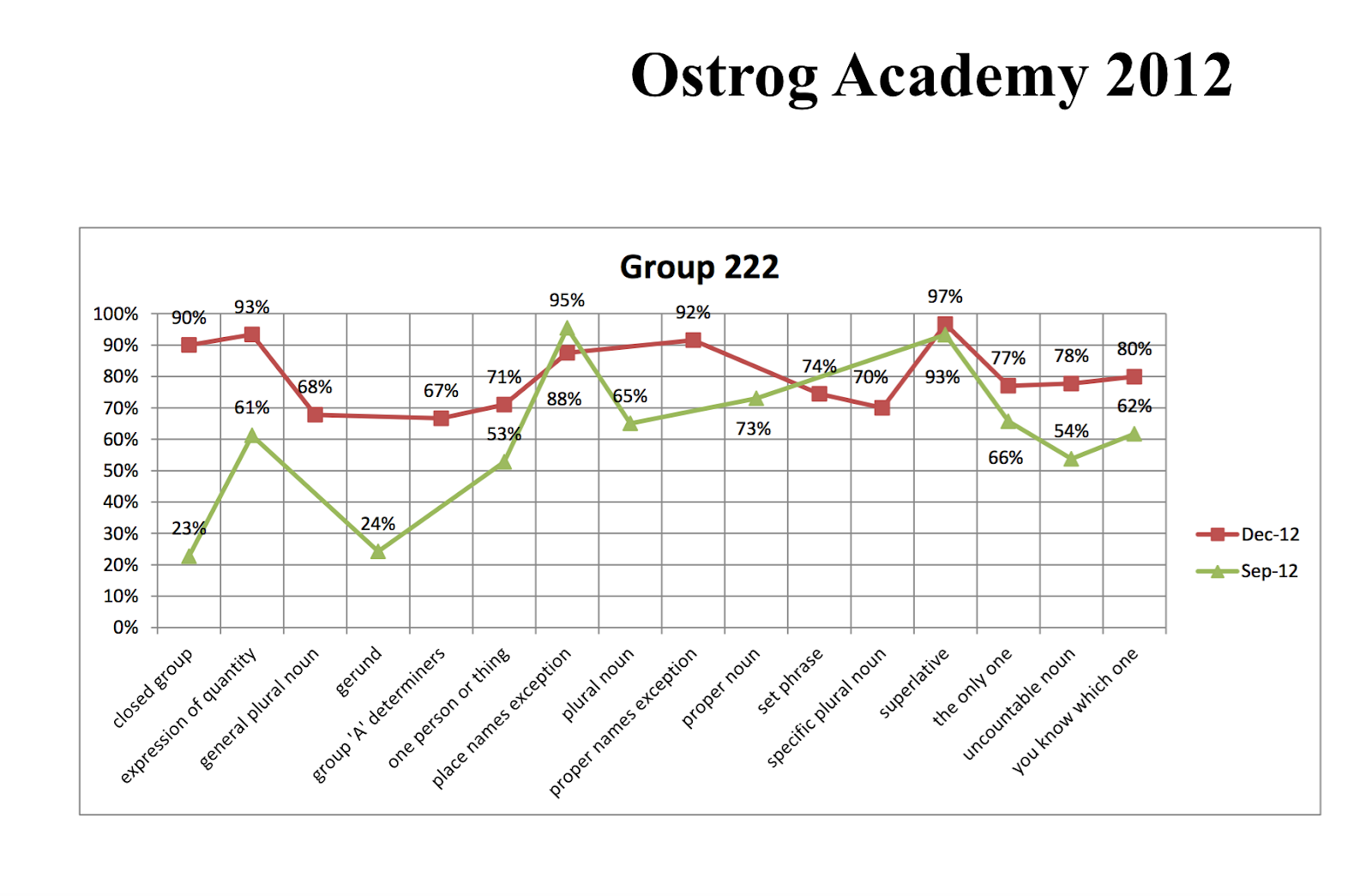
Results of Work In Ostrog 2012


PDF version for better viewing

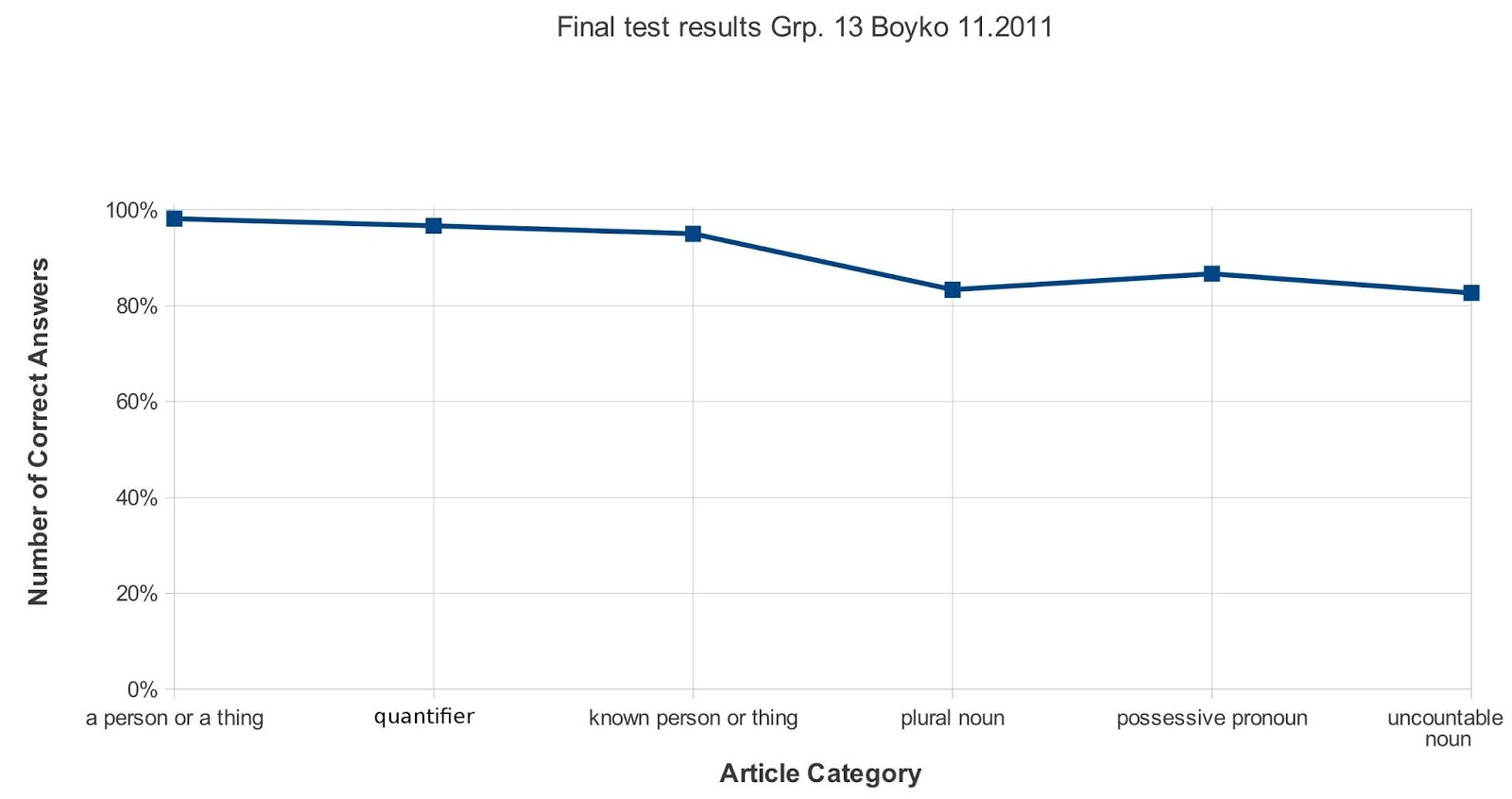
Work group results of the final test, Rivne, 2011


We see great improvement in the work group's final test results.  See the notable measure of improvement.

Control Group and Work Group Test Result Comparison, Rivne 09

Control Group and Work Group Test Result Comparison

Unfortunately we were unable to meet with the students to get the results of the final exam.

COMPARISON OF PROFICIENCY IN ARTICLE USAGE 2012

Chart comparing test results of the Article Pre-test

This chart shows the uniformity of problems with Article Usage.  We compared the results of students at 2 Ukrainian universities: РДГУ, Rivne, and the Ostrog Academy in Ostrog.

RRI research project on the English Article

THE PROBLEM OF THE ENGLISH ARTICLE FOR UKRAINIANS LEARNING ENGLISH AS A SECOND LANGUAGE

 TESOL conference in Rivne, Ukraine April, 2010

 I was visiting a lady who lives near L'viv a few years ago, and near the end of the visit she told me that "the husband was soon coming home..." this little anecdote illustrates the problems of correctly using the article, and the confusion or amusement it can cause for the hearer. These errors are typically use of the article and preposition, also pronunciation and collocation errors which have created a specific “Ukrainian English”.

This course will focus on these types of errors, by alerting students to the error, correcting the error, and with various types of practice hopefully eliminate the error before it becomes fossilized in the students' speech.

 The university has agreed for me to work with the fourth year psychology students who are studying English as their only foreign language. The class is split into 2 subgroups, group A and group B. I will work with one subgroup, the other group is the control group.


At the beginning of the course both groups will take the same test. I will work with group A once a week; group B will not participate in my course. My work with group A will consist of fill in the black exercises, drills, communicative games, role play and other types of activities to teach and reinforce the correct forms in the students' minds. My weekly lessons will follow the set curriculum of the group's normal English classes.


After working with the fourth year students for one year I will administer a test again to both groups to check if there is any improvement in group A in comparison to group B. If students do well on this test I would recommend giving them enough points to raise their mark one point at the end of the spring term. It is too early to have any results yet from our observations, but we have detected some patterns in the errors made, as listed:
 • Percentage of correct answers in English Article test
 • Superlative 90,00%
 • you know which one 63,00%
 • things in general 51,00%
 • plural noun 43,00%
 • only one around 72,00%
 • place names exception 84,00%
 • a closed group with a limited number of members 58,00%
 • uncountable noun 38,00% • proper noun 70,00%
 • one person or thing 55,00% • expression of quantity 74,00%

 The problem of the English article is one that has been explored for many years. Otto Jespersen, a Danish grammarian wrote A Modern English Grammar on Historical Principles. The Article was addressed in this work as well as in other current publications such as The English Article by Stoudinets, published in Kyiv in 2006.

Conclusion A native speaker may be able to detect and correct these errors more readily; the native speaker does face the limitations of never having studied English as a foreign language. This presents certain challenges, such as having to learn grammar rules in order to explain why something doesn't "sound right" But with enough drill and practice of correct article use, it's possible that even a native English speaker will understand the "logic" behind the need for articles in the English language!

Here are the result of pretesting 2 groups of first year student in Rivne.